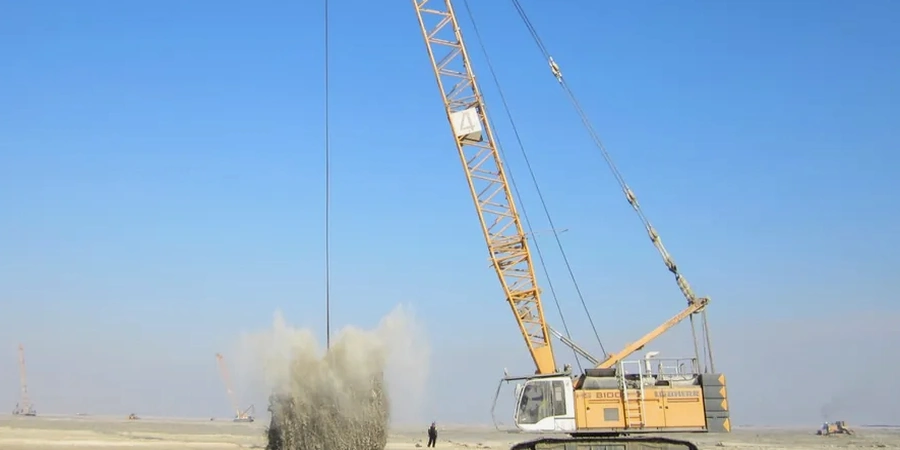
Liverpool sits on Triassic sandstone and glacial till, with the Mersey basin creating variable ground conditions beneath the city. At 70 metres above sea level, the topography here means fill thickness can shift dramatically between adjacent plots. Dynamic compaction design in Liverpool directly addresses this legacy of made ground and loose granular fills left by centuries of port activity. Before applying high-energy tamping, our team cross-references borehole logs with the British Geological Survey's 1:50,000 sheet for Liverpool. We then calibrate drop weight, grid spacing, and number of passes to achieve target relative density. This approach has consistently delivered bearing capacities above 200 kN/m² on reclaimed docklands and former railway yards across the city.
Reaching bearing capacities above 200 kN/m² on Liverpool's reclaimed docklands requires precise calibration of drop energy and grid geometry.
Process overview
Design follows Eurocode 7 (BS EN 1997-1:2004) and the CIRIA C573 report on dynamic compaction. For Liverpool's brownfield sites, we first conduct a detailed site investigation including plate load testing to establish baseline stiffness. The method combines high-energy impact with systematic crater measurement to confirm depth of improvement. Key parameters we control include:
Drop weight: 10 to 20 tonnes, adjusted for fill thickness
Drop height: 10 to 30 metres, depending on target depth
Grid spacing: 4 m to 8 m, with primary and secondary passes
Number of drops per point: 8 to 15, verified by crater volume
Each project in Liverpool receives a site-specific compaction plan that accounts for nearby structures and buried services. The team monitors ground vibration with seismographs to stay within safe limits for heritage assets like the Albert Dock.
Technical reference image — Liverpool
Local context
A six-storey residential block on Liverpool's waterfront required dynamic compaction over a former timber pond filled with loose sand and rubble. The initial design assumed uniform ground, but trial craters revealed pockets of soft clay and buried timber that could not densify. Had these zones been missed, differential settlement would have exceeded 50 mm within the first year. Our solution was to map the anomalies with cone penetration testing, then re-space the compaction grid locally. We applied heavier drops over the clay lenses and backfilled the craters with coarse granular material. The post-compaction modulus of subgrade reaction exceeded 70 MN/m³, and the project was completed without structural claims.
We integrate boreholes, CPT, and geophysics to build a 3D ground model before compaction design. This identifies hidden obstructions and variable fill thickness that affect tamping efficiency.
02
Dynamic Compaction Specification and Supervision
From drop weight selection to crater logging, we carry out on-site engineering supervision during the compaction campaign. Vibration monitoring and settlement plates confirm compliance with design targets.
03
Post-Compaction Verification Testing
After compaction, we run plate load tests, SPTs, and seismic surveys to verify bearing capacity and stiffness. Results are compared against pre-compaction baseline data to demonstrate improvement.
Relevant standards
BS EN 1997-1:2004 (Eurocode 7 – Geotechnical design), CIRIA C573 – Dynamic Compaction: Design and Specification, BS EN ISO 22476-3 (SPT method referenced for verification), BS 5930:2015 (Site investigation code of practice)
Common questions
What types of ground respond best to dynamic compaction in Liverpool?
Loose granular fills, made ground, and reclaimed land respond very well. The technique is less effective in cohesive clays and peat, which are found locally in areas like the Mersey floodplain. A trial area is always recommended to confirm suitability.
How does dynamic compaction affect nearby heritage structures in Liverpool?
Vibration levels are continuously monitored with seismographs. For sensitive buildings like those in the UNESCO World Heritage district, we limit peak particle velocity to 15 mm/s or lower. Grid spacing and drop height can be reduced near boundaries.
How much does dynamic compaction design cost for a typical Liverpool brownfield site?
The typical range for design and supervision is between £950 and £3,290, depending on site area, fill depth, and complexity. This covers ground modelling, specification, and on-site verification. Larger sites with trial areas may fall at the upper end.
What verification methods are used after compaction in Liverpool?
We use plate load tests (BS 1377-9), SPT blow counts, and sometimes cross-hole seismic surveys. Testing is done at multiple depths and locations to confirm relative density and bearing capacity meet the design criteria for the specific development.