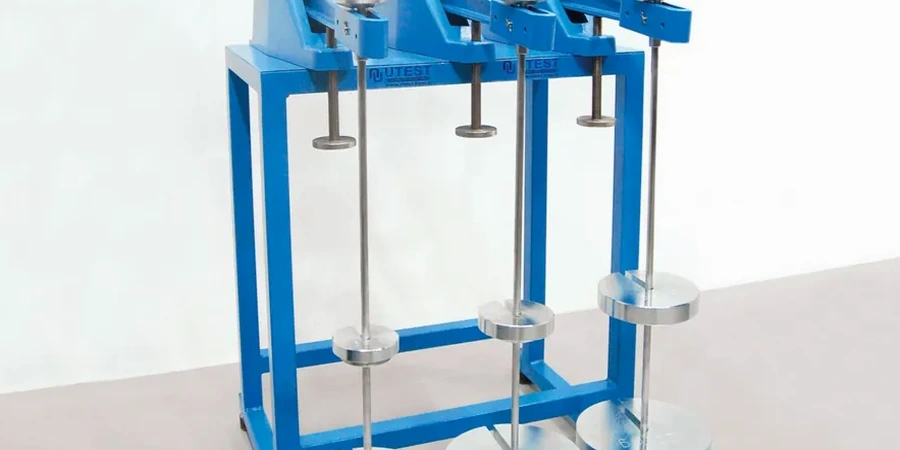
Liverpool's ground conditions are shaped by the Mersey basin and its glacial legacy. Most of the city centre and surrounding suburbs are underlain by thick deposits of soft to firm glacial till and laminated clays, often with a high moisture content near the river. When we run an oedometer consolidation test on samples from sites like the Baltic Triangle or the Wirral approach roads, we consistently see moderate to high compressibility in these strata. Understanding the pre-consolidation pressure and the compression index is critical for predicting long-term settlement under embankments, new builds, or port infrastructure. The oedometer test provides exactly that data — and it is a standard requirement for any project where differential settlement could affect structural performance.
In Liverpool's soft clay layers, the oedometer test reveals pre-consolidation pressures rarely above 200 kPa, making settlement predictions essential for every foundation design.
Process overview
The difference between testing a sample from the city's sandstone ridge around Toxteth and one from the alluvial flats near Sefton Park is significant. On the sandstone, the oedometer curve shows a stiff pre-consolidation stress, often above 300 kPa. In the low-lying areas, the clay layers are softer and more compressible, with the compression index (Cc) ranging from 0.15 to 0.35. We follow the incremental loading procedure per BS 1377-5:1990, typically applying load increments of 12.5, 25, 50, 100, 200, 400, 800 kPa and then unloading. For projects requiring a better understanding of creep behaviour, we also run the oedometer consolidation test alongside a corte directo to define the drained shear strength parameters under similar stress paths.
Technical reference image — Liverpool
Local context
One of the main risks we address in Liverpool is the presence of interbedded sands and silts within the clay layers. During the oedometer consolidation test, these thin bands can cause rapid initial drainage that masks the true consolidation behaviour of the dominant clay matrix. If the test is not interpreted correctly the engineer may underestimate the time-rate of settlement, leading to premature loading on site. Our protocol includes careful visual logging before specimen trimming and, when necessary, running duplicate specimens to verify the cv value. This attention to detail is what separates a reliable test from one that produces misleading data.
Seven load increments from 12.5 to 800 kPa with full unloading-reloading cycle. Includes determination of Cc, Cs, cv, mv, and pre-consolidation pressure. Suitable for typical clay and till profiles found across Liverpool. Report includes consolidation curve and interpretation per BS 1377-5.
02
Long-Term Creep Oedometer (Secondary Compression)
Extended duration test on the final load increment (typically 24 to 72 hours) to measure the secondary compression index (Cα). Essential for sites with organic clay or peat layers, such as those found in the Mersey floodplain. Includes full standard parameters plus creep analysis.
Relevant standards
BS 1377-5:1990 (Methods of test for soils — Part 5: Compressibility, permeability and durability tests), BS EN 1997-2:2007 (Eurocode 7: Ground investigation and testing), BS 1377-5/D2435M-11 (Standard Test Method for One-Dimensional Consolidation Properties of Soils), ISO/TS 17892-5:2004 (Geotechnical investigation and testing — Laboratory testing of soil — Part 5: Incremental loading oedometer test)
Common questions
What is the typical cost of an oedometer consolidation test in Liverpool?
For a standard incremental loading test with seven increments and full reporting, the cost generally ranges between £180 and £390 per specimen. The variation depends on the number of load increments, whether a creep stage is included, and the urgency of the turnaround. We can carry out a fixed quote once the number of specimens and the required load schedule are confirmed.
How long does the oedometer test take before I get results?
A standard test with seven load increments takes between 7 and 10 working days from sample receipt to final report, assuming each load step is left for 24 hours. If you need faster data for a design decision, we can run a reduced schedule with four to five increments in about 5 days. The creep test adds an extra 2 to 3 days depending on the duration selected.
Why is the oedometer test important for Liverpool's clay soils?
Liverpool's glacial till and laminated clays are notoriously variable in compressibility. Without an oedometer test you cannot reliably predict the magnitude or rate of settlement under a new building or embankment. The test gives you the compression index (Cc) and the coefficient of consolidation (cv) — both essential for designing foundations that avoid differential movement, especially on sites near the Mersey where groundwater levels are high and the clay is soft.