Liverpool sits on a complex mix of glacial till, soft alluvium, and made ground. The water table is often shallow near the Mersey, especially in the docklands and Everton slopes. For any cut or fill exceeding 3 m, we run a phased slope stabilization design. The first step is a site walkover and borehole layout. Then we extract undisturbed samples for triaxial testing. We also install standpipes to monitor pore pressure. All data feeds into limit-equilibrium models (Bishop, Spencer) per Eurocode 7. Before final design, we often recommend a resistivity survey to map hidden weak zones or buried streams.
Glacial till can hide laminated clay lenses. A phased investigation picks them up before your factor of safety drops below 1.3.
Process overview
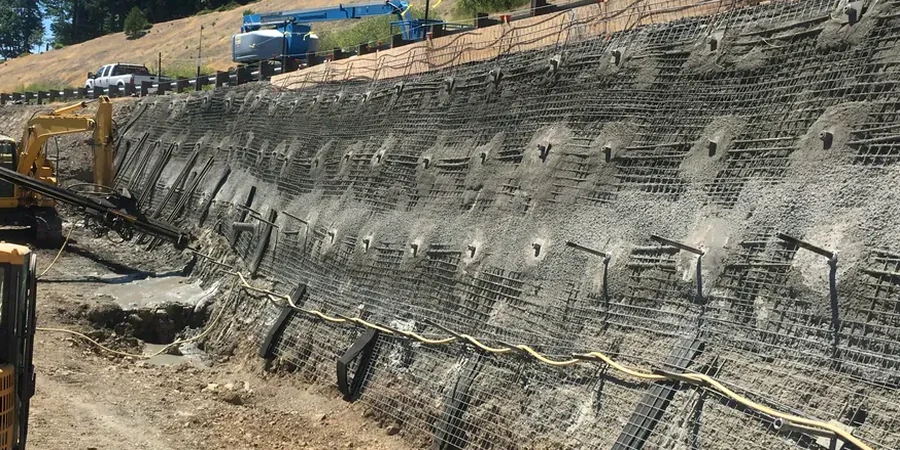
A recent project in Toxteth required stabilizing a 9 m slope behind a new residential block. The ground was glacial till over laminated clay. We set up five boreholes to 15 m depth and took U100 samples. In the lab we ran consolidated undrained triaxial tests (CIU) and direct shear. The peak friction angle came to 28°, cohesion 5 kPa. We used those values in SLOPE/W to check long-term drained conditions. For the critical slip surface, the factor of safety was 1.15 — below the 1.3 target. That meant we needed soil nails and a drainage blanket. We also used piezometer data to model seasonal water rise. That changed the design pore pressure ratio from 0.25 to 0.35.
Technical reference image — Liverpool
Local context
Eurocode 7 and BS 6031 set clear requirements for slope stabilization design in Liverpool. The main hazard here is perched water in the till and old mine workings under the eastern suburbs. A heavy rain event can raise pore pressure by 30% in 24 hours. That alone can drop the factor of safety below 1.0. We always run a sensitivity analysis for worst-case water levels. If the slope has existing cracks or tension features, we flag them immediately. The cost of a shallow failure in a built-up area — road closure, utility damage, legal claims — far exceeds the cost of proper design upfront.
This service complements our laboratory testing work for a complete project analysis.
Technical data
Parameter
Typical value
Peak friction angle (CIU)
27° – 34°
Cohesion (drained)
3 – 12 kPa
Bulk unit weight
19 – 21 kN/m³
Pore pressure ratio (ru)
0.25 – 0.40
Factor of safety target
1.3 – 1.5 (ULS)
Additional services
01
Detailed Site Investigation for Slopes
Boreholes, trial pits, and In-Situ (SPT, CPT, vane shear) to characterize stratigraphy and strength. We install piezometers to monitor seasonal water levels, then run lab triaxial and direct shear tests on undisturbed samples.
02
Stability Analysis & Remedial Design
Limit-equilibrium and finite-element modelling (SLOPE/W, Plaxis) for both drained and undrained conditions. We design soil nails, anchored walls, drainage systems, or reprofiling to achieve the required factor of safety per Eurocode 7.
Relevant standards
Eurocode 7 (BS EN 1997-1:2004), BS 6031:2009 – Code of practice for earthworks, FHWA-NHI-05-039 – Mechanically Stabilized Earth Walls, CIRIA C760 – Guidance on embedded retaining walls
Common questions
What are the typical causes of slope instability in Liverpool?
The main causes are shallow groundwater after heavy rain, weak laminated clay layers within the glacial till, and old mine workings in the east of the city. Steep cuts made during the Victorian era also leave many slopes under-designed by modern codes.
What is the typical cost range for a slope stabilization design study in Liverpool?
For a residential-scale slope (5-10 m high), expect between £1.430 and £4.770 depending on the number of boreholes, lab tests, and complexity of the model. The final price depends on access, ground variability, and required analyses.
How long does a slope stabilization design project usually take?
A standard project takes 4 to 8 weeks from site visit to final report. The drilling phase takes 1-2 weeks, lab testing 2-3 weeks, and modelling and reporting another 1-2 weeks. Urgent projects can be fast-tracked with parallel lab work.
Do I need planning permission for slope stabilization works in Liverpool?
Yes, most slope stabilization works require planning permission from Liverpool City Council, especially if it involves retaining walls over 1 m, earthmoving over 50 m³, or works near a listed structure. We carry out the geotechnical data you need for the application.