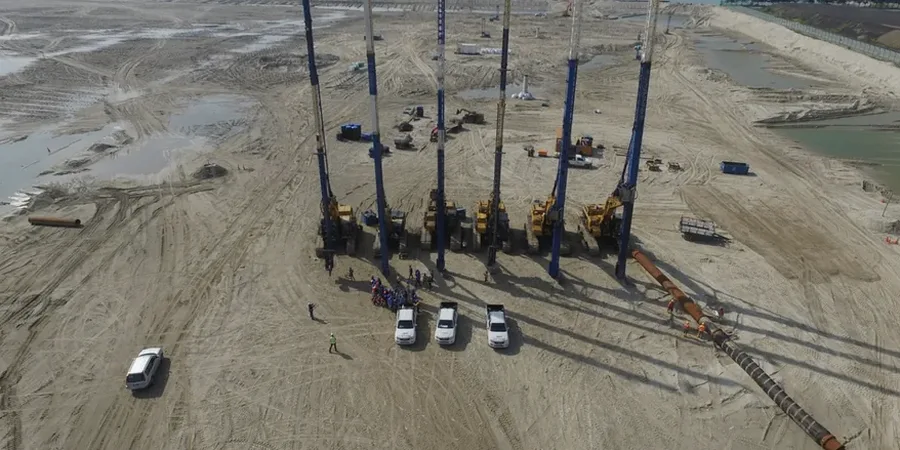
Liverpool's tidal Mersey and thick alluvial deposits create a unique challenge for any development on soft ground. The city's historic docks and reclaimed waterfront areas, like the Liverpool Waters site, sit on layers of soft clay and silt that consolidate slowly under load. Without engineered drainage, settlement can drag on for years. That is where prefabricated vertical drain design comes in. PVDs accelerate consolidation by providing short horizontal drainage paths within the compressible layer. Before specifying a drain pattern, we always run a consolidation test on undisturbed samples to determine Cv and Cc. The data feeds directly into the spacing calculation.
PVD spacing directly controls consolidation time; a 1.0 m grid can cut primary settlement duration from years to weeks.
Process overview
Liverpool sits at sea level, with much of the city centre built on made ground and soft Holocene clays. The population of around 496,000 relies on transport links that cross these same compressible soils. A typical PVD design here must account for smear zone effects and well resistance. Our approach follows Eurocode 7 and includes the following steps:
Laboratory oedometer tests to measure coefficient of consolidation (Cv)
Radial drainage analysis using Barron's or Hansbo's solution
Spacing optimisation for target 90% consolidation within construction programme
We also cross-check with a CPTu to map thin sand lenses that could act as natural drains. Where layered soils are present, we apply a subsurface drainage model to avoid overestimating performance.
Technical reference image — Liverpool
Local context
A common mistake in Liverpool is assuming PVDs alone solve the settlement problem. Without a preload surcharge equivalent to the design load, the drains have no driving head. We have seen cases where contractors installed drains at 1.5 m centres but only applied 50 % of the required surcharge. The result: residual settlement after handover. The correct sequence is to design the preload height first, then verify the PVD spacing achieves the required time to consolidation. A preload and surchargeanalysis is essential before any drain layout is finalised.
Oedometer tests with incremental loading to determine Cv, Cc, and pre-consolidation pressure. Results used directly in radial drainage calculations.
02
Drain Pattern Design
Spacing and depth calculations using Hansbo's and Barron's solutions. We optimise for programme and cost, accounting for smear and well resistance.
03
Preload & Surcharge Design
Determination of fill height and staged loading sequence to achieve required effective stress. Includes stability checks for soft clay foundations.
04
Installation QA/QC
Specification of mandrel size, insertion rate, and verticality tolerance. Field verification of drain continuity and discharge capacity.
Relevant standards
Eurocode 7 (EN 1997-1:2004), BS 5930:2015 – Code of practice for ground investigations, FHWA NHI-16-072 – Prefabricated Vertical Drains (US practice, adapted for UK)
Common questions
How does PVD design differ in Liverpool compared to other UK cities?
Liverpool's shallow soft clay layers, often 5–15 m thick, require narrower drain spacing than stiffer sites. The high water content (up to 80 %) means smear zone effects are more pronounced, so we typically use a 1.2–1.8 m triangular grid. We also account for tidal groundwater fluctuations near the Mersey.
What is the typical cost range for a PVD design package in Liverpool?
A full design package, including consolidation testing, spacing calculations, and a preload analysis, typically ranges from £620 to £1,980. The final cost depends on site area, number of soil layers, and whether additional field tests like CPTu are needed.
Can PVDs work on Liverpool's reclaimed docklands?
Yes, but the fill material varies widely. On sites like the Liverpool Waters development, we first verify that the fill does not contain obstructions that could damage the drain jacket. We also recommend a trial installation if the fill includes rubble or ash. PVDs are effective as long as the underlying clay is free-draining laterally.