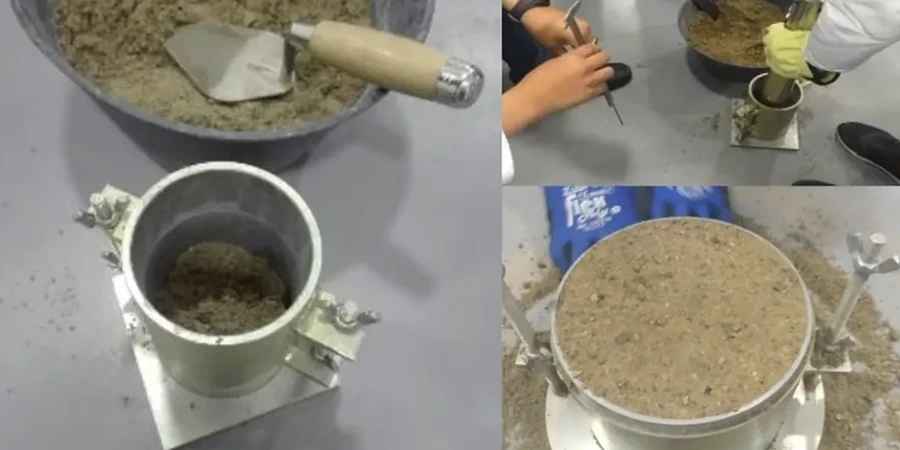
Liverpool sits on a varied bedrock of Triassic Sherwood Sandstone overlain by glacial till and alluvial deposits from the Mersey Estuary, with ground conditions shifting dramatically within a few hundred metres. For any earthworks project here—whether a new housing development in Knowsley or a road widening on the A565—the Proctor test determines the optimum moisture content and maximum dry density of imported or on-site fills. Standard Proctor (BS 1377-4:1990) suits light compaction scenarios like backfill, while Modified Proctor matches higher energy requirements for sub-base layers under highways. Before mobilising rollers, we often cross-check results with a plate load test to verify in-situ stiffness, or use a field density test for rapid quality control on compacted lifts. The Mersey's high groundwater table means moisture sensitivity is a real concern, so reliable laboratory data is non-negotiable.
A reliable compaction curve from a Proctor test reduces the risk of settlement or rutting by matching field moisture to the material's optimum.
Process overview
On a recent industrial estate near Speke, we tested fills derived from local sandstone and recycled demolition aggregate. The process follows BS 1377-4:1990 for both Standard and Modified energy levels—each requiring a specific rammer weight, drop height, and number of blows per layer. Key parameters we report include maximum dry density (MDD), optimum moisture content (OMC), and a compaction curve plotted from five points. Typical MDD for Liverpool's glacial till ranges 1.8–2.0 Mg/m³ with OMC around 12–16%. For modified energy, expect 0.1–0.2 Mg/m³ higher density and 2–4% lower OMC. We complement the test with direct shear on compacted specimens to assess shear strength, and particle size analysis when the fill contains oversize material that affects compaction behaviour. Our lab holds UKAS accreditation (ISO 17025), ensuring every result is defensible for design or specification compliance.
Technical reference image — Liverpool
Local context
Liverpool's urban expansion since the 18th century has left a legacy of variable made ground, old dock infill, and reworked glacial deposits. The 1950s–70s saw extensive housing estates built on poorly compacted fills along the eastern suburbs, many of which now show differential settlement or serviceability issues. A Proctor test performed on the actual borrow material—not a assumed value—prevents over-optimistic compaction targets. When fills contain demolition rubble or ash, the test identifies whether the material can achieve the required density at a practical moisture content. Skipping this step risks under-compaction, leading to long-term maintenance costs that far outweigh the laboratory fee.
596 kJ/m³ (2.5 kg rammer, 305 mm drop, 3 layers x 27 blows)
Modified Proctor energy (BS 1377-4)
2685 kJ/m³ (4.5 kg rammer, 457 mm drop, 5 layers x 27 blows)
Mould diameter
105 mm (standard) or 152 mm (modified for coarser material)
Typical MDD range (Liverpool glacial till)
1.80–2.00 Mg/m³
Typical OMC range (Liverpool glacial till)
12–16%
Maximum particle size accepted
20 mm (standard mould) / 37.5 mm (large mould)
Additional services
01
Standard Proctor Test (BS 1377-4:1990)
Determines the optimum moisture content and maximum dry density for soils and fills using a 2.5 kg rammer at 596 kJ/m³ energy. Suitable for general fill, backfill, and low-traffic subgrades. Report includes compaction curve, MDD, and OMC.
02
Modified Proctor Test (BS 1377-4:1990)
Uses a 4.5 kg rammer at 2685 kJ/m³ energy to simulate higher compaction effort, matching specifications for road sub-base, airfield pavements, and heavy-duty industrial floors. Ideal for materials that will be compacted with heavy rollers in the field.
Relevant standards
BS 1377-4:1990 (Compaction related tests), BS EN 1997-2:2007 (Eurocode 7 – Ground investigation and testing), BS 1377-4-12e2 (Standard Proctor – reference for international projects), BS 1377-4-12e1 (Modified Proctor – reference for international projects)
Common questions
What is the difference between Standard and Modified Proctor tests?
The key difference is the compaction energy applied. Standard Proctor uses a 2.5 kg rammer dropped from 305 mm over three layers (596 kJ/m³), while Modified Proctor uses a 4.5 kg rammer dropped from 457 mm over five layers (2685 kJ/m³). Modified energy is roughly 4.5 times higher, yielding a higher maximum dry density and lower optimum moisture content. Choose Standard for general fills and Modified for high-spec road or pavement layers.
How much does a Proctor test cost in Liverpool?
Typical cost for a Standard Proctor test ranges £80–£120 per sample, and a Modified Proctor test £100–£150 per sample. Prices vary depending on sample preparation, number of points on the curve, and whether oversize material requires a large mould. Contact us for a fixed quote based on your specific material and project volume.
How long does it take to get results from a Proctor test?
Standard turnaround is 3–5 working days from sample receipt. If the material needs drying or preparation (e.g., removing particles >20 mm), add 1–2 days. Express service (next day) is available for urgent site decisions, subject to lab capacity.
Can you test cohesive and non-cohesive soils from Liverpool sites?
Yes, the Proctor test is suitable for both cohesive soils (clays, tills) and granular soils (sands, gravels) provided the maximum particle size does not exceed 20 mm for the standard mould or 37.5 mm for the large mould. For very coarse fills, we can discuss alternative methods like the vibrating hammer test (BS 1377-4:1990, Method 3).