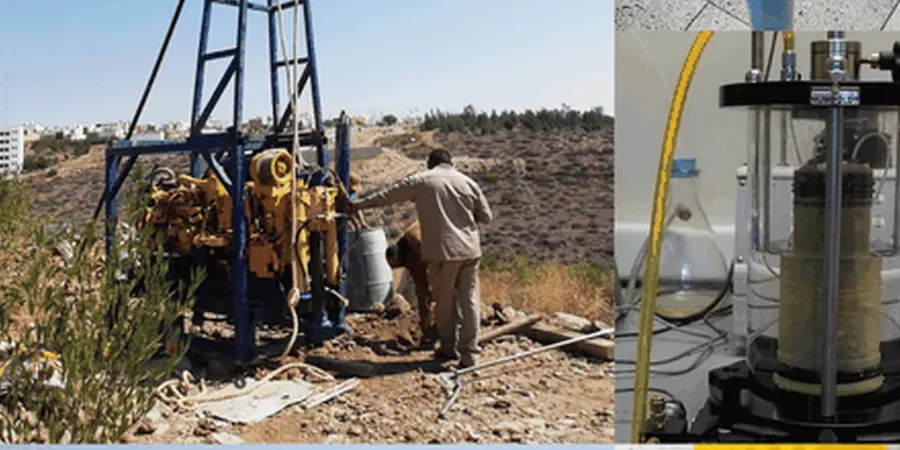
Too many Liverpool contractors skip the soil mechanics study and only realise the mistake when the ground shifts under the foundation. We have seen it happen on a three-storey block in Edge Hill where the bearing stratum was overestimated by 0.5 m. That single error cost the developer £18 000 in remedial piling. A proper soil mechanics study in Liverpool gives you the actual shear strength, moisture content and groundwater profile before you pour a single cubic metre of concrete. It is not paperwork – it is the cheapest insurance you can buy for your project. Before starting any excavation, we recommend pairing the soil mechanics study with a test pit inspection to visually confirm the stratigraphy, and with laboratory permeability tests when the site has clay layers that can trap water.
A soil mechanics study in Liverpool is the cheapest insurance you can buy – it converts ground uncertainty into design confidence.
Process overview
The geology of Liverpool is dominated by the Sherwood Sandstone Group in the east and the Mercia Mudstone Group in the west, with extensive superficial deposits of glacial till and alluvial sands along the Mersey. Groundwater tends to sit between 2 m and 5 m depth in the city centre, and that shallow water table can cause instability in even a moderate excavation. A complete soil mechanics study in Liverpool addresses these local conditions by measuring the natural moisture content, bulk density and shear strength parameters. We follow BS 5930:2015 for site investigation and BS EN 1997‑2 for geotechnical design. The workflow includes:
Disturbed and undisturbed sampling using Shelby tubes
Classification tests: Atterberg limits, particle size distribution (BS 1377‑2)
Strength tests: triaxial (UU, CU, CD) and direct shear
Consolidation test (oedometer) for settlement predictions
Each parameter feeds into the geotechnical model that your structural engineer relies on.
Technical reference image — Liverpool
Local context
A five-storey apartment block near the Leeds-Liverpool Canal in Bootle had to stop works last year because the soil mechanics study was carried out after excavation. The contractor had already cut 3 m into what looked like firm clay, but a heavy rain event turned the exposed face into a slurry. Without the study, they did not know the plasticity index of the clay or the effective stress parameters. The collapse damaged two adjacent garages and delayed the project by 11 weeks. That risk is entirely avoidable. A soil mechanics study in Liverpool identifies the actual behaviour of the ground under load and under water – it tells you whether you need temporary shoring, dewatering, or a different foundation type before you break ground.
Mobilisation to your Liverpool site, trial pits or window sampling, undisturbed and disturbed soil collection, and on-site logging of strata.
02
Classification tests suite
Atterberg limits, particle size distribution, moisture content and density – all performed in our UKAS-accredited laboratory following BS 1377.
03
Strength and stiffness characterisation
Triaxial compression (UU, CU, CD) and direct shear tests to obtain shear strength parameters for foundation and slope design.
04
Consolidation and settlement analysis
Oedometer tests to quantify compressibility, pre-consolidation pressure and settlement magnitude – essential for buildings on soft alluvial deposits.
Relevant standards
BS 5930:2015 – Code of practice for site investigations, BS EN 1997‑2:2007 – Eurocode 7 – Ground investigation and testing, BS 1377‑2:1990 – Methods of test for soils – Classification tests, BS 1377‑7:1990 – Shear strength tests (triaxial)
Common questions
How long does a soil mechanics study in Liverpool take?
A standard study covering sampling, classification and basic strength tests takes 3 to 4 weeks from site visit to final report. If you need accelerated turnaround for a fast-track project we can prioritise the critical tests and deliver the main results within 10 working days.
What does a soil mechanics study cost in Liverpool?
The cost depends on the number of test pits or boreholes, the suite of laboratory tests and the depth of investigation. For a typical residential development with two trial pits and a full classification plus triaxial suite, the price ranges between £2,590 and £4,570. Complex brownfield sites with multiple phases may be higher – we always quote on a per-project basis.
Do I need a soil mechanics study for a single-storey extension?
Yes, if the extension is built on clay or in an area with a high water table – both common in Liverpool. Without the study you risk differential settlement or heave. A simplified study with a few classification tests and one triaxial is usually sufficient for small projects.
Which certification does your laboratory hold?
Our laboratory is UKAS accredited to ISO 17025 for the geotechnical tests listed on our schedule. This means the results are recognised by building control, structural engineers and insurance companies without additional validation.