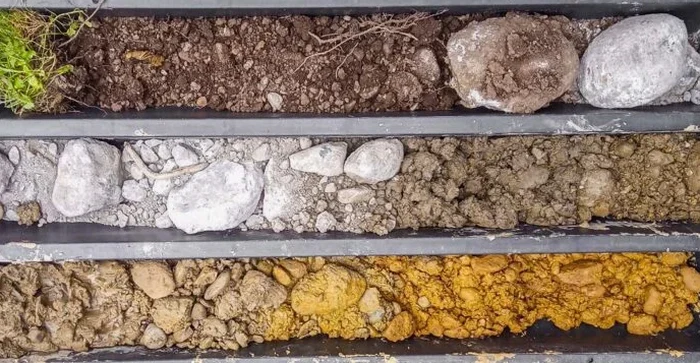
Liverpool's damp maritime climate and legacy of industrial fill mean the ground is notoriously variable. A proper exploratory test pit gives you the eyes to see exactly what's beneath the surface before you break ground. We dig these pits by hand or machine to expose soil strata, check for old foundations, and sample for lab testing. It's a direct, visual method that's especially useful on tight inner-city sites near the Albert Dock or the newer developments around the Knowledge Quarter. Before we start any test pit work, we always check for buried utilities and secure the necessary permits from Liverpool City Council. The information gathered here then feeds directly into the foundation design, whether we're looking at shallow footings or deeper solutions. For projects where the soil profile looks complex, we often recommend combining the test pit with a corte directo on undisturbed samples to get accurate shear strength parameters for the bearing layers.
What you can see in a test pit — cobbles, old foundations, perched water — no borehole log can fully replace.
Process overview
We follow BS 5930:2015 and Eurocode 7 (EN 1997-1:2004) strictly for all our exploratory test pit work in Liverpool. After excavating to the required depth, our geotechnical engineer logs the soil profile in detail, recording colour, consistency, moisture content, and any signs of contamination. We take bulk disturbed samples for classification and undisturbed block samples for strength testing. These are sealed, labelled, and sent to our UKAS-accredited lab within 24 hours. The on-site team also performs hand shear vane tests on cohesive layers and carries out observation for groundwater seepage. A typical test pit in the Merseyside area runs 2.5 to 4.0 metres deep, depending on the target stratum. On sites with shallow bedrock or dense glacial till, we may need to stop earlier. The entire process is logged with photos and GPS coordinates. For brownfield sites, we can also use the pit to assess the feasibility of jet grouting as a Improvement method if soft zones are encountered.
Technical reference image — Liverpool
Local context
Liverpool sits on a mix of glacial till, alluvial deposits, and made ground. The key risk? Unrecorded fill from the city's 19th-century expansion can hide old cellars, culverts, or industrial waste. A single unexplored pocket of soft ground under a strip footing could cause differential settlement — and a very expensive call-back. That's why a systematic exploratory test pit programme is the first line of defence. We grid the site and space pits according to BS 5930 guidelines, ensuring no hidden surprises. On sloping ground near the Wirral side, we also check for perched water tables that could soften clay layers. Our findings directly inform the decision on whether to proceed with shallow foundations or switch to a pilotes solution for the deeper load-bearing strata.
Detailed logging of each stratum encountered, including colour, plasticity, moisture, and consistency. Photographed and recorded to BS 5930 format.
02
Undisturbed Block Sampling
Hand-trimmed block samples for lab triaxial or direct shear tests. Essential for obtaining accurate strength parameters for foundation design.
03
Groundwater & Infiltration Assessment
Observation of water strikes, seepage rates, and perched water tables. Data used to inform dewatering needs and drainage design.
04
Contamination Screening (Brownfield)
Visual and olfactory screening for hydrocarbons, asbestos, or other contaminants. Samples sent for chemical analysis if required.
This service complements our laboratory testing work for a complete project analysis.
Relevant standards
BS 5930:2015 Code of practice for ground investigations, Eurocode 7 (EN 1997-1:2004) Geotechnical design, Health & Safety Executive (HSE) – Excavation Regulations
Common questions
How deep can an exploratory test pit go in Liverpool?
Typical depths range from 2.5 to 4.0 metres, limited by machine reach, ground stability, and the water table. In areas with shallow glacial till or bedrock, we may stop earlier. For deeper investigations, we switch to boreholes.
What is the typical cost range for a test pit investigation in Liverpool?
For a standard programme of 3 to 5 pits on a residential site, expect a cost range between £380 and £570 per pit. This includes excavation, logging, sampling, and a summary report. Final price depends on depth, number of pits, and any lab testing required.
Do you need council permits to dig test pits in Liverpool?
Yes, if the pit is on a highway verge, pavement, or public open space, a Section 50 license from Liverpool City Council is required. On private land, no permit is needed, but we always check for buried operations before starting.