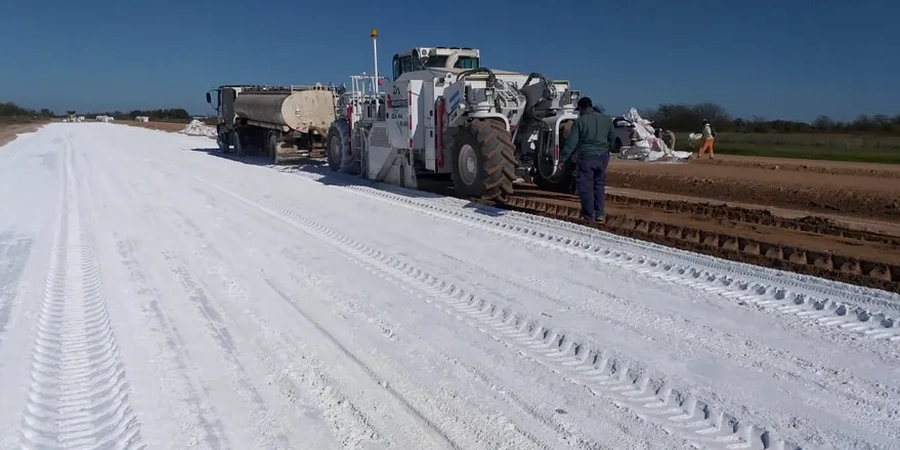
The ground beneath Liverpool is a mixed bag. We see glacial till overlying Triassic sandstone in the city centre, but toward the docks and along the Mersey floodplain you hit soft alluvial clays and peat layers. That soft ground is where lime and cement stabilization becomes essential. Instead of digging out poor material and importing expensive fill, we treat it in place. The process changes the soil's moisture content and plasticity, creating a working platform that can support structural loads. In our expertise, this method saves weeks on project programmes along the waterfront. We often pair it with a placa de carga to verify the improved bearing capacity before foundations go in.
Treating soft alluvial clay in Liverpool with lime and cement can lift CBR from under 2% to over 15%, slashing pavement thickness and imported fill costs.
Process overview
We follow BS EN 1997-2 and the UK's Specification for Highway Works (SHW Series 600) when designing lime and cement stabilization mixes. For Liverpool's typical clayey soils we start with a laboratory assessment of the natural moisture content and Atterberg limits. Then we determine the optimum binder content — usually between 3% and 8% by dry weight of soil. The key is to react the lime first to reduce plasticity, then add cement to gain strength. We have treated ground for a retail park in Speke where the original clay had a plasticity index over 40%; after stabilization the PI dropped below 20% and the CBR rose from under 2% to over 15%. That sort of improvement lets you reduce pavement thickness significantly. Our lab is UKAS-accredited to ISO 17025 and we certify every batch.
Technical reference image — Liverpool
Local context
The biggest mistake we see on Liverpool sites is skipping the initial laboratory mix design. Contractors order a standard 5% cement addition, spread it, and hope for the best. That almost never works on the city's variable glacial till or the organic silts near the docks. Without a proper assessment of the natural pH and sulphate content, the cement can fail to hydrate properly or, worse, cause heave due to sulphate attack. We had to redo a section of access road in Birkenhead where the untreated subgrade had high sulphates — the cement stabilisation had to be redesigned with a sulphate-resisting binder. A little lab work upfront avoids a full-depth removal later.
Typical unconfined compressive strength after 7 days
0.5 – 2.0 MPa
Plasticity index reduction
40% – 60% of initial value
CBR improvement (typical range)
From <3% to >12%
Mixing depth (single pass)
200 – 600 mm
Setting time before trafficking
24 – 72 hours
Design life of treated layer
20+ years under standard UK traffic
Additional services
01
Laboratory Mix Design
We test your site's soil to determine the optimum lime and cement content, including plasticity index, pH, sulphate level, and compaction characteristics. This step is critical for achieving consistent strength and long-term durability. Results are delivered with full UKAS-accredited certification.
02
On-Site Treatment Supervision
Our engineers monitor the spreading, mixing, and compaction of the stabilised layer. We carry out field density tests and in-situ CBR checks to confirm the specified performance is met. We can also arrange for a densidad cono arena test to verify compaction uniformity across the treated area.
03
Sulphate Resistance Assessment
Given Liverpool's history of industrial fill and variable ground chemistry, we always check for soluble sulphates before specifying cement-based stabilisation. Where levels are high, we recommend alternative binders or a modified mix design to prevent heave and long-term degradation.
04
Quality Control Testing
We carry out independent QC during and after stabilisation works. This includes unconfined compressive strength tests on cored samples, pH monitoring, and periodic CBR re-checks. All results are documented in a formal report suitable for client and regulatory approval.
Relevant standards
BS EN 1997-2:2007 (Eurocode 7 – Ground investigation and testing), BS 5930:2015 (Code of practice for site investigations), SHW Series 600 – Earthworks (UK Design Manual for Roads and Bridges), BS 1377 (Standard guide for evaluating effectiveness of admixtures for soil stabilization)
Common questions
What types of soil in Liverpool respond best to lime and cement stabilization?
The best results come from the soft alluvial clays and silts found along the Mersey floodplain and around the docks. These typically have high plasticity and low natural strength. Glacial till can also be improved, though the mix design needs to account for variable gravel content. Peat and very organic soils do not respond well and usually require a different treatment method.
How much does lime and cement stabilization cost in Liverpool?
For a typical project in the Liverpool area, expect to pay between £740 and £1.950 depending on the area to be treated, the required depth of stabilisation, and the complexity of the mix design. The lower end covers shallow treatment of a small site; the upper end includes full laboratory design, on-site supervision, and comprehensive QC testing. Contact us for a quote specific to your site.
How long does lime and cement stabilization take to achieve full strength?
Initial strength gain is rapid — you can usually traffic the treated layer after 24 to 72 hours. However, the chemical reactions continue for several weeks. The 7-day unconfined compressive strength typically reaches about 70% of the 28-day value. We design the mix so that the 7-day strength meets the project's early-loading requirements, and we confirm the 28-day value with laboratory tests on samples taken from site.
Do I need planning permission or environmental permits for ground stabilization in Liverpool?
In most cases, lime and cement stabilization is considered a Improvement technique and does not require planning permission if it is part of an approved development. However, if you are working near a watercourse or in a designated conservation area, you may need an environmental permit from the Environment Agency. We recommend checking with Liverpool City Council's planning department early in the project. Our team can carry out the technical data needed for any permit application.