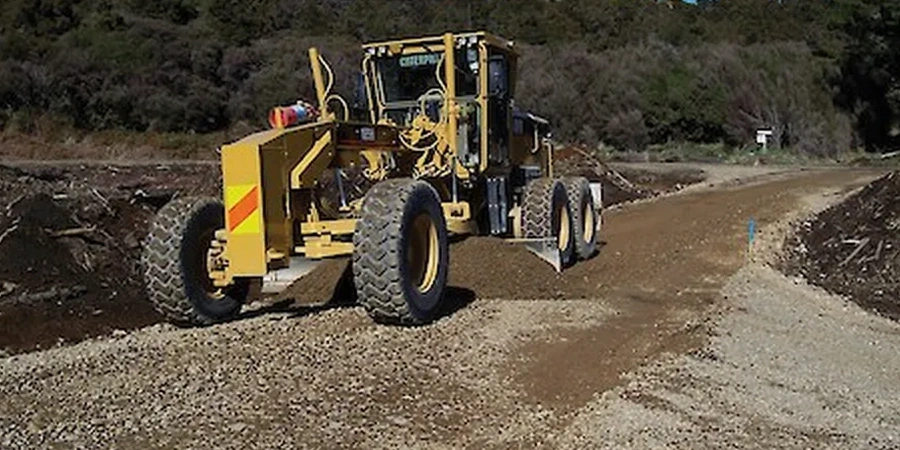
Designing a road subgrade in Liverpool demands compliance with BS 5930:2015 for site investigation and Eurocode 7 (EN 1997-1:2004) for geotechnical design. The city's underlying geology — largely Mercia Mudstone overlain by glacial till and alluvial deposits from the Mersey — creates variable bearing capacities and drainage conditions that directly affect pavement performance. We integrate in-situ CBR testing, plate load tests, and laboratory compaction trials to produce subgrade reaction moduli that withstand heavy traffic loads and the region's 800 mm annual rainfall. Before defining the subgrade design parameters, we often run a plate load test to validate the modulus of subgrade reaction under real stress conditions, ensuring the pavement layers perform as predicted over their service life.
For principal roads in Liverpool, a minimum CBR of 15% is often required — natural glacial till may need lime or cement stabilisation to reach that target.
Process overview
In Liverpool, many projects overlook the effect of high groundwater tables on subgrade strength, especially near the Albert Dock or along the Wirral peninsula. Our approach starts with dynamic cone penetrometer surveys to map strength profiles quickly, then samples for laboratory California Bearing Ratio tests under soaked conditions — replicating the worst-case winter moisture regime. We classify soils using the Unified Soil Classification System (USCS) per BS EN ISO 14688-2, and determine the optimum moisture content via the modified Proctor test (BS 1377-4). A typical road subgrade design in Liverpool requires a minimum CBR of 5% for light traffic and 15% for principal roads; when natural soils fall short, we specify stabilisation with lime or cement to raise the design strength economically. The table below summarises key parameters we evaluate for every project.
Technical reference image — Liverpool
Local context
The humid maritime climate of Liverpool, with over 140 rainy days per year, creates a persistent risk of subgrade softening during construction. Traffic loading on a saturated subgrade can cause rutting and premature pavement failure within months. We mitigate this by designing drainage blankets, geotextile separation layers, and specifying compaction at 2% above optimum moisture to leave a safety margin. Without a solid road subgrade design that accounts for the Mersey's tidal groundwater fluctuations, even a well-constructed pavement will develop differential settlement and cracking within the first winter cycle.
We perform California Bearing Ratio tests in-situ (BS 1924-2) and dynamic cone penetrometer surveys to map subgrade strength profiles rapidly across the site, identifying weak zones that require treatment before pavement construction.
02
Laboratory Soil Classification & Compaction
Full classification including Atterberg limits, particle size distribution, and modified Proctor compaction (BS 1377) to determine optimum moisture content and maximum dry density. Soaked CBR tests simulate worst-case moisture conditions for Liverpool's climate.
03
Subgrade Stabilisation Design
When natural soils fall below required CBR, we design economical stabilisation with lime, cement, or fly ash. We specify dosage rates, mixing depths, and curing periods to achieve target strength while minimising construction costs.
Relevant standards
BS 5930:2015 — Code of practice for ground investigations, BS EN 1997-1:2004 (Eurocode 7) — Geotechnical design, BS 1377-4:1990 — Methods of test for soils: Compaction-related tests, TRRL Report LR 1132 — Road Note 31: Guide to the structural design of pavements
Common questions
What is the typical CBR value for Liverpool's glacial till?
Glacial till in Liverpool typically yields soaked CBR values between 3% and 8% in its natural state. After compaction at optimum moisture content, values can reach 10–12%, but for principal roads requiring 15% CBR, lime or cement stabilisation is usually necessary.
How much does a road subgrade design study cost in Liverpool?
For a standard road project in Liverpool, expect costs between £810 and £2,200 depending on site area, number of CBR tests needed, and laboratory work. This includes DCP surveys, soil classification, compaction tests, and a design report with stabilisation recommendations if required.
Why is soaked CBR testing important for Liverpool roads?
Liverpool receives over 800 mm of rain annually with high winter groundwater tables. Soaked CBR testing (4-day soak) replicates the worst-case moisture conditions that the subgrade will expertise during its service life, ensuring the pavement design is conservative enough to prevent early failure.
What is the difference between in-situ and laboratory CBR tests?
In-situ CBR tests measure the subgrade strength directly in the field at natural moisture content, while laboratory CBR tests are performed on compacted samples at controlled moisture and density. For Liverpool's road subgrade design, we use both: in-situ for spot checks during construction, and laboratory soaked CBR for design values.