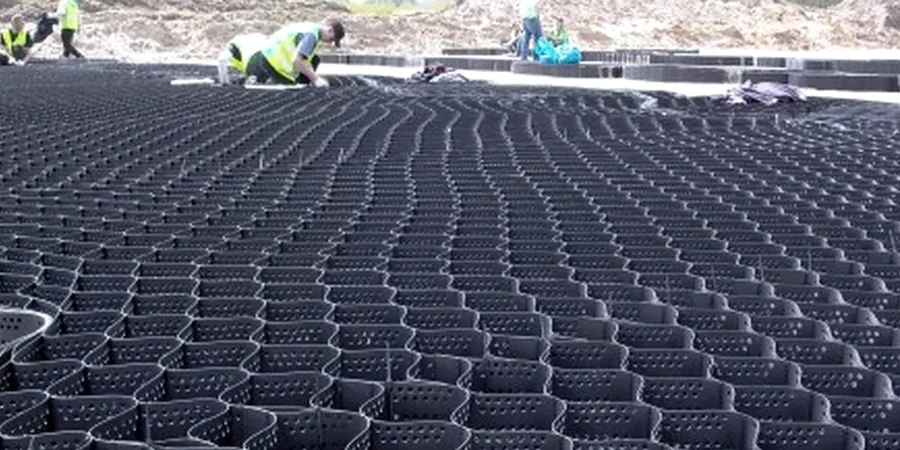
Liverpool's ground conditions are notoriously mixed. We work on glacial till overlying sandstone, but also thick sequences of made ground from the city's industrial past. High groundwater, combined with soft pockets, demands a reinforcement system that distributes loads effectively. Geocell design in Liverpool addresses this by confining granular fill within a 3D cellular matrix. It increases the stiffness of the working platform and prevents lateral spreading. Our team has designed geocell systems for access roads, crane pads, and temporary haul routes across the Mersey corridor. We calibrate each design using site-specific shear strength parameters and the bearing capacity model from Eurocode 7. Before specifying the cell geometry, we often run a plate load test to validate the subgrade modulus at working stress.
A geocell system designed for 60-tonne axle loads needs a verified subgrade CBR and a validated interface friction angle to avoid differential settlement.
Process overview
In Liverpool we see a recurring pattern: contractors treat the fill as a structural layer without verifying the subgrade beneath. That is a mistake. A proper geocell design in Liverpool starts with understanding the CBR of the natural ground. We then select the cell height, weld spacing, and polymer grade based on the traffic class and fill type. The system works best when paired with a separation geotextile to prevent intermixing. To confirm the confinement effect, we model the composite section using the British Standard for reinforced soil. In many cases we also run a direct shear test on the fill material to define the interface friction angle. For long-term performance, we check the creep behaviour of the geocell strips under sustained load. We have designed systems for 5-tonne to 60-tonne axle loads, and each one is tailored to the site-specific moisture regime. When the groundwater is high, we integrate a drainage layer beneath the geocell mattress to prevent pore pressure build-up.
Technical reference image — Liverpool
Local context
The most common error we see in Liverpool is assuming that a single geocell layer can bridge a variable subgrade. If the ground beneath contains soft pockets of alluvial clay or uncompacted fill, the cell system can punch through locally. That leads to differential rutting and a failed platform. Another risk is ignoring the groundwater regime. A rise in the water table after heavy rain can reduce the effective stress in the fill, dropping the confinement benefit by up to 40 %. We always model the worst-case phreatic surface and specify a drainage layer where necessary. Without that check, the geocell design in Liverpool becomes a gamble on the weather.
This service complements our laboratory testing work for a complete project analysis.
Technical data
Parameter
Typical value
Cell height range
75 mm – 200 mm
Polymer grade
HDPE or PP (UV-stabilised)
Weld spacing
330 mm – 445 mm
Design traffic class
T1 to T6 (BS 6031)
Fill type
Granular, maximum particle size < 0.75 x cell height
Subgrade CBR design range
1 % – 8 %
Factor of safety (bearing)
2.0 – 2.5 (Eurocode 7)
Additional services
01
Temporary Access Road & Haul Route Design
For construction sites with heavy plant movements, we design geocell-reinforced access roads using a 150 mm cell height and well-graded crushed rock fill. We verify the subgrade CBR with In-Situ and model the traffic loading to ensure the platform lasts for the project duration without major maintenance.
02
Crane Pad & Working Platform Design
Crane pads require a stiffer composite section. We use a 200 mm cell height and specify a high-density polyethylene grade for long-term creep resistance. Our design includes a separation geotextile and a drainage layer to keep the fill dry under repeated loading. We validate the bearing capacity with a plate load test before the crane arrives.
03
Slope & Embankment Stabilisation with Geocells
On sloping ground or embankments, geocells confine the fill and increase the shear resistance at the interface. We design the cell system to resist sliding and toe failure, factoring in the slope angle, fill density, and groundwater conditions. The design follows the limit-state approach of Eurocode 7 with partial factors applied to the driving forces.
Relevant standards
BS EN 1997-1:2004 (Eurocode 7 – Geotechnical design), BS 6031:2009 (Code of practice for earthworks), BS 8006-1:2010 (Code of practice for strengthened/reinforced soils and other fills)
Common questions
What is the typical cost range for a geocell design in Liverpool?
For a standard access road or crane pad design, the cost typically falls between £720 and £2,170 depending on the site area, subgrade variability, and the number of design iterations required. This includes the ground model, traffic analysis, and a design report with installation drawings. Contact us for a project-specific quote.
How does the geocell design account for the made ground found across Liverpool?
Made ground in Liverpool varies widely, from dense brick rubble to loose ash and clinker. We take site-specific samples and run a direct shear test and a compaction test on the fill material. The geocell design then uses a reduced interface friction angle to account for particle degradation. We also check the subgrade for any soft pockets that could cause differential settlement.
Can a geocell system be used on slopes in Liverpool's residential areas?
Yes, but only after a thorough slope stability analysis. We model the existing slope geometry, groundwater conditions, and the shear strength of the underlying soil. The geocell system is designed to resist sliding and to distribute the load from the retained fill. For residential slopes we typically use a 100 mm cell height and a geotextile separator to prevent erosion.