Liverpool’s development as a port city reshaped its geology. Victorian docks, warehouses, and later redevelopments like the Albert Dock sit on varied ground: glacial till, made ground, and alluvial deposits along the Mersey. Understanding how those soils behave under load is critical. The Plate Load Test (PLT) directly measures bearing capacity and deformation modulus at formation level. It fills the gap between theoretical calculations and real performance. Before committing to a foundation design, we often run a calicatas exploratorias to log strata, then apply PLT where stiff clays or compact fills need proof of capacity.
For Liverpool’s glacial tills, PLT moduli typically range 40–120 MN/m², directly validating the design’s bearing resistance at formation level.
Process overview
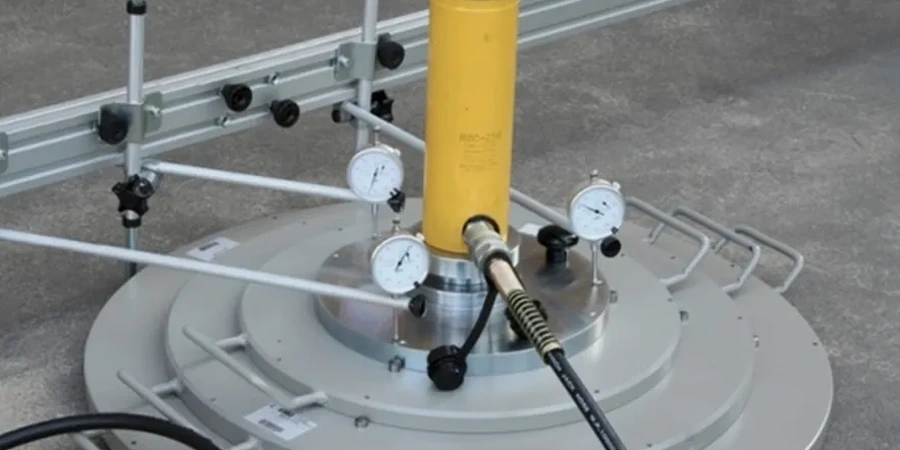
BS 5930 and Eurocode 7 (EN 1997-1:2004) guide our PLT execution in Liverpool. The test consists of seating a steel plate on a prepared surface and applying increments of load while recording settlement. We use a reaction frame with kentledge or a hydraulic jack system. The load-settlement curve yields the modulus of subgrade reaction (ks) and the ultimate bearing capacity. In Merseyside’s glacial tills, we typically see moduli between 40 and 120 MN/m². For verification against design assumptions, complementing with an ensayo SPT provides a continuous profile of resistance. Key parameters we report include:
Plate diameter: 300 mm, 600 mm or 762 mm (custom sizes on request)
Load increments: 10% of estimated failure load per stage
Settlement criteria: 0.5 mm stabilisation per increment
Duration: 4–8 hours per test point
Technical reference image — Liverpool
Local context
The PLT rig includes a reaction frame, kentledge blocks, and a hydraulic pump. In Liverpool’s constrained city-centre sites – think tight alleyways behind Georgian terraces or active dockyard areas – manoeuvring the equipment demands careful planning. We use steel cribbing to spread the kentledge load and avoid localised bearing failure beneath the reaction beams. The test area must be level, free of loose debris, and protected from weather. Rain on Merseyside can soften a clay surface before the plate is seated, biasing the first settlement readings. We always prepare a drying bed of sharp sand or a thin concrete pad when conditions are damp.
ks, modulus of deformation, ultimate bearing capacity
Additional services
01
PLT for Shallow Foundations (Pad & Strip Footings)
Verification of bearing capacity for pad and strip footings on glacial till or engineered fill. We test at two plate sizes (600 mm and 762 mm) and carry out a load-settlement curve, ks value, and allowable bearing pressure. Typically completed within one day per test point.
02
PLT for Piled Raft & Improvement Validation
For sites where Improvement – vibrocompaction, stone columns, or dynamic compaction – has been applied, PLT confirms the achieved modulus. We set up on the improved surface and run staged loading to 1.5 times the design working load. Full report includes modulus of deformation and comparison with design assumptions.
This service complements our laboratory testing work for a complete project analysis.
Relevant standards
BS 5930:2015 (Code of practice for ground investigations), Eurocode 7: EN 1997-1:2004, BS 1377 (Standard Test Method for Bearing Capacity of Soil for Static Load and Spread Footings)
Common questions
How does a Plate Load Test differ from an SPT in Liverpool?
SPT measures resistance to dynamic penetration at depth, giving a profile of N-values. PLT directly applies a static load at formation level, measuring settlement and bearing capacity. The two complement each other: SPT for profiling, PLT for proof of capacity.
What is the typical cost range for a PLT in Liverpool?
For a single test point with a 600 mm plate and reaction frame, the cost is between £580 and £980. Multiple test points or larger plates may adjust the price. This range includes mobilisation, setup, testing, and a full report.
Can PLT be performed on soft ground or made ground?
Yes, but the plate must be seated on a prepared surface. On soft ground, the reaction frame may require additional kentledge or a larger footprint. We assess site access and ground conditions during the quote stage to advise on feasibility.