In Liverpool, the combination of dense glacial till overlying sandstone bedrock creates a unique drainage challenge. Many sites we assess here have perched water tables that fluctuate rapidly after heavy rain, something the local Merseyside ground conditions amplify. A solid geotechnical drainage design is not just about pipes and gravel — it requires understanding pore pressure dissipation and the hydraulic gradient across the site. For cut slopes along the Mersey corridor, we often pair the drainage strategy with a stability analysis of slopes to verify that the phreatic surface stays below the failure plane. Similarly, when basements are proposed in the city centre, a permeability test in the field gives us the actual k-value of the till, which is rarely uniform. That data then feeds directly into the drainage layout and sump sizing.
A 0.5 m rise in the phreatic surface can reduce slope safety factor by 30% — drainage design is the control valve.
Process overview
A common mistake contractors make in Liverpool is assuming the sandy lenses within the till will drain freely — they don't. Those lenses are often discontinuous, so a blanket drainage blanket without proper cut-off trenches can leave a site saturated. Effective geotechnical drainage design here must account for the anisotropy of the glacial deposits. We always verify the stratification first with a trial pit investigation to map the gravel horizons and clay seams. The key parameters we target include:
Hydraulic conductivity (k) from falling-head tests on undisturbed samples
Particle size distribution of the granular drain material per BS 882
Filter design criteria to prevent piping of fines into the drainage aggregate
Without these checks, drainage systems in Liverpool's urban infill sites can fail within the first winter. We also apply consolidation testing when the clay layers are thick, because the rate of settlement from dewatering must be predicted accurately.
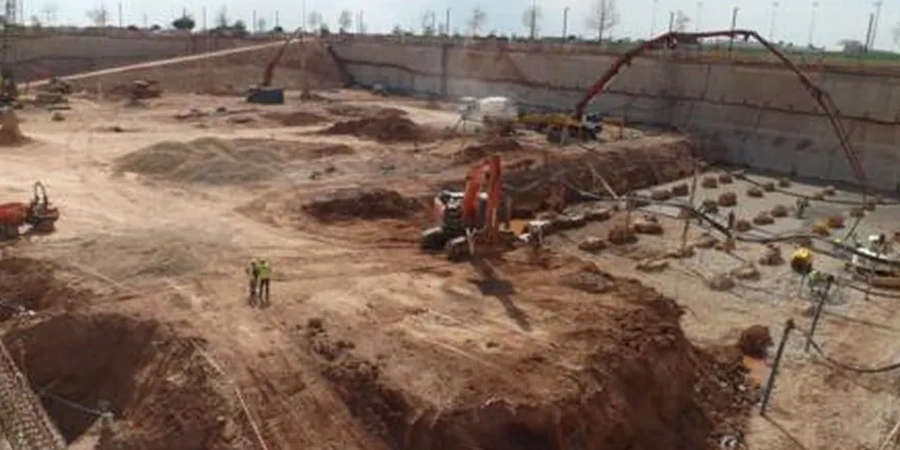
Technical reference image — Liverpool
Local context
We saw a four-storey student accommodation block in the Knowledge Quarter where the original drainage design used a single gravel trench along the rear wall. After a wet February, water built up behind the basement and the wall showed horizontal cracking. The geotechnical drainage design we did for the retrofit used a fin-drain system connected to a pumped sump, with a redundant gravity overflow to the combined sewer. The lesson is clear: in Liverpool's clay-dominated ground, passive drainage alone is rarely sufficient — you need an actively monitored system that accounts for the city's 800 mm annual rainfall.
We produce a drainage concept plan based on site topography, soil permeability, and groundwater regime. This includes location of cut-off drains, blanket drains, and sumps, with preliminary sizing using Darcy's law and flow-net analysis.
02
Detailed Design & Verification
Detailed calculations for pipe diameters, filter gradation, and pumping capacity. We verify the design against BS 5930 and CIRIA C760, and issue a drainage design report suitable for Building Regulations approval.
03
Construction Support & Testing
On-site supervision during drain installation, including permeability testing of placed drainage layers, filter compatibility checks, and as-built documentation. We also monitor groundwater levels post-construction to confirm design performance.
Relevant standards
BS 5930:2015 – Code of practice for ground investigations, Eurocode 7 (EN 1997-1:2004) – Geotechnical design, BS EN 1997-2:2007 – Ground investigation and testing, CIRIA C760 – Guidance on the design of drainage systems
Common questions
What is geotechnical drainage design and why does Liverpool need it?
It is the design of subsurface drainage systems to control groundwater, relieve pore pressure, and prevent water damage to foundations, retaining walls, and slopes. Liverpool's glacial till and high water table make it essential for any basement or deep excavation.
What standards govern drainage design in Liverpool?
The primary standards are BS 5930 for ground investigation, Eurocode 7 for geotechnical design, and CIRIA C760 for drainage specifics. Local authority guidance may also apply for surface water discharge.
How do you determine the drainage requirements for a site?
We start with a site investigation including trial pits, falling-head permeability tests, and groundwater monitoring. The hydraulic conductivity and seasonal water table fluctuations dictate the drain spacing, depth, and discharge method.
How much does geotechnical drainage design cost in Liverpool?
For a typical residential or small commercial site, the design fee ranges between £690 and £1,930 depending on complexity, site area, and the level of investigation required. A full design with construction support is at the upper end.
Can drainage design prevent slope failure in Liverpool?
Yes. A properly designed drainage system can lower the phreatic surface below the critical failure plane, increasing the factor of safety by 0.3 to 0.5. Combined with slope geometry and soil strength, it is one of the most cost-effective mitigation measures.