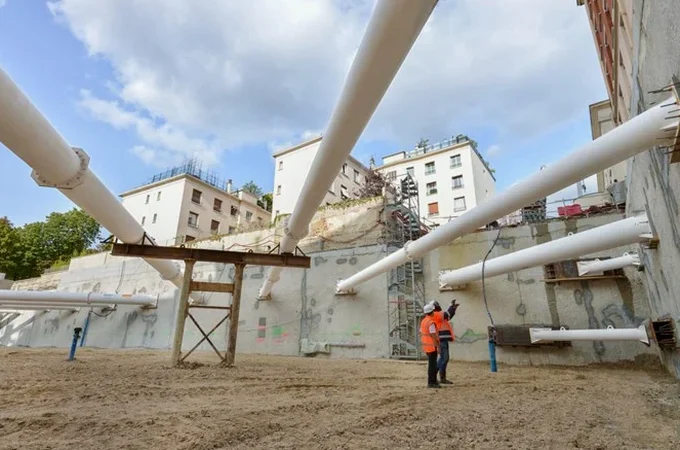
On sites across Liverpool's waterfront and eastern suburbs, the preloading system typically involves excavator-placed fill layers reaching 3 to 6 m in height, with staged surcharge berms designed to accelerate primary consolidation. The equipment spread includes vibrating rollers for compaction control, settlement plates connected to automated dataloggers, and pneumatic piezometers installed at multiple depths. For projects in the Merseyside region, this approach directly addresses the high compressibility of the underlying alluvial clays and peat deposits that characterise the Mersey Valley. Before specifying the surcharge geometry, the team verifies the consolidation parameters through a consolidation test on undisturbed samples and cross-checks settlement rates using field permeability testing in standpipe piezometers.
Preloading with surcharge in Liverpool's soft ground typically requires 90 days of monitored consolidation to achieve 90 percent primary settlement before structure load.
Process overview
The local geology along the Mersey Estuary presents a typical sequence of soft silty clay and laminated sand over glacial till, with groundwater levels often within 1.5 m of the surface. Preloading with surcharge design in Liverpool must account for undrained shear strengths as low as 15 kPa in the upper 4 m, which governs the maximum fill placement rate to avoid bearing failure. The design methodology follows the Asaoka graphical method for settlement projection, coupled with a minimum preload period of 90 days for embankments exceeding 2.5 m of surcharge. Field monitoring includes rod settlement gauges and pneumatic piezometers installed at 2 m intervals. The engineering team integrates these readings with a dilatometer test profile to capture the horizontal coefficient of consolidation for layered soil models.
Technical reference image — Liverpool
Local context
With a population exceeding 500,000 and much of the city centre built on reclaimed docklands and alluvial floodplains, Liverpool faces a distinct geotechnical risk: differential settlements between structures founded on preloaded ground and those on untreated natural ground. The soft estuarine clays under the Baltic Triangle and Knowledge Quarter can undergo up to 300 mm of consolidation under a 4 m surcharge. If the preload is removed prematurely, secondary compression settlements may add another 50 mm over 10 years, affecting serviceability of rigid pavements and building slabs. Properly designed preloading with surcharge mitigates these risks by matching the load magnitude and duration to the project-specific coefficient of consolidation from oedometer tests.
One-dimensional consolidation analysis using Terzaghi's theory, calibrated against oedometer data from the site. Includes staged fill schedules, surcharge height optimisation, and pore pressure dissipation modelling. Outputs include time-settlement curves, post-construction residual settlement estimates, and instrumentation layout plans.
02
Field monitoring and performance verification
Installation and weekly readout of settlement plates, pneumatic and vibrating wire piezometers, and inclinometers at the perimeter of the surcharge area. Data reduction includes Asaoka plots and comparison with design predictions. A verification report certifies the degree of consolidation achieved before surcharge removal.
Relevant standards
BS EN 1997-1:2004 (Eurocode 7) — Geotechnical design, BS 5930:2015 — Code of practice for ground investigations, CIRIA C580 — Embankment design on soft ground
Common questions
How does preloading with surcharge work on Liverpool's soft clays?
The surcharge fill applies a vertical stress exceeding the final service load, forcing pore water out of the compressible alluvial clays and accelerating primary consolidation. In Liverpool's ground, where the coefficient of consolidation typically ranges from 2 to 8 m²/year, a 3 m surcharge can achieve 90 percent consolidation in 90 to 120 days. The preload is removed once the monitored settlement curve confirms the target degree of consolidation.
What monitoring instruments are used during the preload period?
Standard instrumentation includes settlement plates at the base of the surcharge, pneumatic or vibrating wire piezometers at 2 m depth intervals to track pore pressure dissipation, and inclinometers at the embankment toe to detect lateral movement. Readings are taken weekly during the main consolidation phase and daily during the first 30 days when pore pressure response is most rapid.
What is the typical cost range for a preloading with surcharge design in Liverpool?
The design and monitoring package for a typical site in Liverpool ranges from £750 to £1,810, depending on the surcharge volume, number of instrument locations, and the duration of field monitoring. This includes the settlement analysis, instrumentation supply and installation, weekly data collection, and a verification report for surcharge removal.
Can preloading be combined with vertical drains for deeper soft deposits?
Yes, where the soft clay layer exceeds 8 m depth, preloading with surcharge is often paired with prefabricated vertical drains (PVDs) installed on a triangular grid at 1.2 to 1.8 m spacing. The drains reduce the drainage path length, shortening the consolidation period from months to weeks. This combination is common on Liverpool's Knowsley Business Park and Wirral waterfront sites where thick alluvium is present.