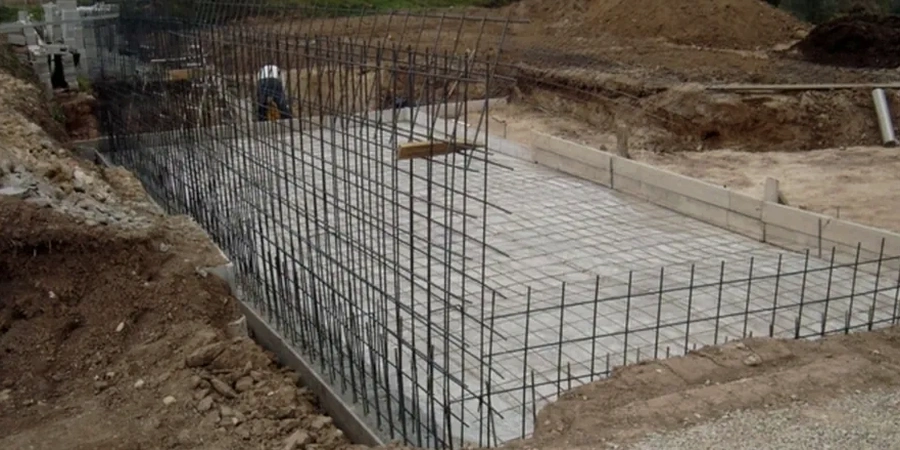
Eurocode 7 (EN 1997-1:2004) sets the framework for shallow foundation design across the UK, but Liverpool’s ground conditions demand a local reading of the code. The city sits mainly on Triassic sandstone and Mercia Mudstone, often overlain by glacial till or made ground from its industrial past. We have designed pad foundations for low-rise housing in Woolton and strip footings for warehouse extensions in Speke, always correlating the code’s partial factors with site-specific strength parameters. Before any bearing capacity calculation, we dig a test pit to log the strata directly — it eliminates the guesswork that boreholes alone can leave. That hands-on check is the first step toward a safe, economical shallow foundation.
On Mercia Mudstone in Liverpool, a plate load test can cut foundation concrete volume by 18% versus a purely code-based design.
Process overview
A common mistake we see in Liverpool is assuming the Mercia Mudstone provides uniform bearing capacity across the whole site. It does not. The mudstone can vary from a stiff clay to a weak rock within a few metres. We always run a plate load test on the exposed formation to measure the actual settlement modulus under working loads. This avoids the over-design that comes from conservative tables and the under-design that can lead to differential settlement. Our process includes: logging the excavation face, classifying the material per BS 5930, performing hand penetrometer checks on cohesive layers, and then interpreting the plate test data to set a characteristic bearing resistance. The result is a foundation that fits the ground, not a generic rule.
Technical reference image — Liverpool
Local context
Compare the ground beneath the Georgian Quarter with that in the Dingle. The Quarter benefits from firm sandstone at shallow depth, allowing traditional strip footings with minimal excavation. Dingle, built on deep estuarine alluvium overlying glacial till, presents a very different picture. Here, shallow foundations must account for soft compressible layers that can cause long-term settlement. We have seen projects where the designer relied on published maps and ended up with a raft foundation twice as thick as needed. A dedicated ground investigation with trial pits and SPT profiles is the only way to know what you are building on. Liverpool’s geology rewards local data every time.
Allowable bearing capacity (strip on glacial till)
100 – 200 kN/m²
Minimum foundation depth (frost protection)
0.9 m
Design modulus of subgrade reaction (k-value)
20 – 60 MN/m³
Partial factor for permanent actions (EQU)
1.35 (EN 1990)
Additional services
01
Pad and Strip Foundation Design
Sizing and detailing of isolated and continuous footings using characteristic ground parameters from site-specific testing. We optimise width and depth to match the actual bearing resistance of Liverpool’s Triassic sandstone or glacial till.
02
Raft Foundation Design
Structural analysis and detailing of reinforced concrete rafts for sites with variable ground conditions. We model differential settlement using modulus values derived from plate load tests on the actual formation level.
03
Foundation Settlement Analysis
Immediate and consolidation settlement calculations using oedometer data from undisturbed samples. We carry out predicted settlements under serviceability loads and recommend mitigation if tolerances are exceeded.
Relevant standards
BS EN 1997-1:2004 (Eurocode 7 – Geotechnical design), BS 5930:2015 (Code of practice for ground investigations), BRE Digest 365 (Soakaway design, relevant for foundation drainage)
Common questions
What is the typical cost range for a shallow foundation design report in Liverpool?
For a standard residential project, the geotechnical design report including site visit, plate load test interpretation, and foundation sizing typically falls between £1.330 and £2.860. The final figure depends on the number of foundation types and the complexity of the ground model.
How deep should a strip foundation be in Liverpool clay soils?
In the glacial till and alluvial clays found across Liverpool, we generally specify a minimum depth of 0.9 m to avoid frost action and seasonal volume change. Where trees are present, depths may increase to 1.2 m or more depending on the tree height and soil desiccation zone.
Can I use published bearing capacity tables instead of a site investigation?
Published tables give a starting point, but the variability of Liverpool’s made ground and mudstone makes them risky. A site investigation with trial pits and a plate load test provides site-specific values that often allow a more economical design and reduce the risk of differential settlement claims.