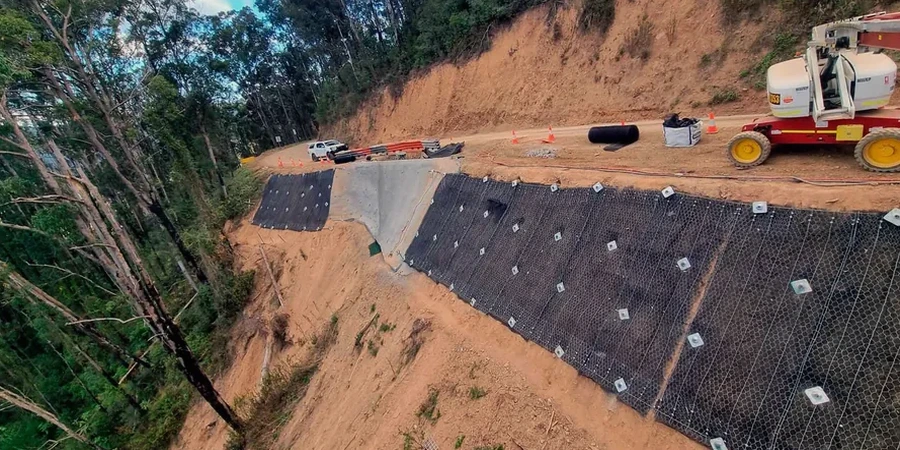
The difference is stark between a cut slope in Woolton, where Triassic sandstone sits close to the surface, and an embankment along the Mersey estuary, underlain by soft alluvial clays and peat. Slope stability analysis in Liverpool must account for this variability, because the same geometry can yield a factor of safety above 1.5 in rock and below 1.0 in saturated clay. For a site in Toxteth, where superficial deposits are thin but groundwater is high, we combine limit-equilibrium methods with monitoreo de taludes to capture seasonal pore-pressure changes; on the Wirral side, where glacial tills dominate, the focus shifts to residual shear strength along pre-existing shear surfaces. Every analysis starts with a ground model built from boreholes and laboratory tests, then we run the numbers against Eurocode 7 partial factors.
A slope that passes Eurocode 7 in dry summer conditions may fail after 48 hours of Liverpool winter rain.
Process overview
We use a trailer-mounted coring rig that reaches 25 m depth on the gentle slopes of Calderstones Park, but for steeper faces near the Liverpool Cathedral, we switch to a portable rotary rig that drills at 45 degrees. The crew sets up inclinometer casings and standpipes during the same mobilization, which saves days compared to separate visits. While the rig works, the field team performs
hand shear vane tests at every 0.5 m in cohesive layers,
seismic refraction surveys along the slope crest and toe,
and groundwater monitoring every 4 hours with dataloggers.
Back in the lab, we run direct shear and triaxial tests on undisturbed samples, then input the strength parameters into Slide2 for circular and non-circular failure surfaces. When the geology includes weak interbeds, we add corte directo tests on the specific seam to capture the peak and residual envelope. For fills and old quarry backfills, we often recommend suelos-colapsibles testing because a sudden settlement can trigger a retrogressive failure that no routine analysis would predict.
Technical reference image — Liverpool
Local context
A 15-meter-high fill slope built for a housing development in Speke failed two winters ago, not because the material was weak, but because a blocked culvert raised the water table 3 m in 48 hours. The factor of safety dropped from 1.4 to 0.9 overnight. That project ended up costing 18 months of delay and remedial grouting. In Liverpool, the main risk is not the geology itself but the combination of high-plasticity glacial till, a humid maritime climate that keeps soils near saturation, and legacy drainage that nobody documents. Without a transient seepage analysis that models a 1-in-100-year storm, you are basically gambling with the stability of the entire slope.
Steady-state or transient (rainfall return period 1:100 yr)
Software
Slide2, SLOPE/W, FLAC 2D
Additional services
01
Limit-Equilibrium Analysis
Bishop, Janbu, and Morgenstern-Price methods for circular and non-circular failure surfaces. We run sensitivity analyses on c', phi', and water table height to identify the controlling parameter.
02
Finite-Element / Finite-Difference Analysis
FLAC 2D and PLAXIS for complex stratigraphy, strain-softening materials, and progressive failure. Output includes displacement contours and shear strain localization zones.
03
Probabilistic Stability Assessment
Monte Carlo simulation on the factor of safety, using site-specific variability from lab tests. We report probability of failure (Pf) and reliability index (beta) per Eurocode 7.
Relevant standards
BS 6031:2009 (Code of practice for earthworks), Eurocode 7 (EN 1997-1:2004) – Design approaches 1 and 3, FHWA-NHI-11-032 (Soil slopes and embankments design guide), Highways England CD 225 (Design of new earthworks)
Common questions
What factor of safety does the UK building code require for slope stability in Liverpool?
For permanent works, Eurocode 7 (EN 1997-1) sets a minimum factor of safety of 1.3 under the ultimate limit state, but BS 6031 recommends 1.5 for long-term stability. In Liverpool, where glacial till can lose strength during wet winters, most local authorities interpret the code as requiring 1.4 unless a probabilistic analysis proves otherwise.
How much does a slope stability analysis cost for a typical housing development in Liverpool?
A full analysis including field investigation, lab testing, and numerical modeling ranges between £870 and £3,310, depending on the number of cross-sections, the complexity of the stratigraphy, and whether transient groundwater modeling is needed. The average for a 2-hectare site with three slope sections is about £2,100.
Can you do the analysis without drilling boreholes on a steep slope in the Sefton area?
Not reliably. Surface mapping and geophysics can give a preliminary picture, but to get the effective stress parameters (c', phi') that govern stability, you need undisturbed samples from boreholes or test pits. We have drilled on slopes up to 35 degrees using our portable rig with a safety winch system.
What is the difference between limit-equilibrium and finite-element methods for slope analysis?
Limit-equilibrium methods assume a rigid body sliding along a defined surface and give a single factor of safety. Finite-element methods model stress and strain throughout the slope, so they can show progressive failure, strain localization, and the effect of construction sequence. For Liverpool clay slopes, we often use limit-equilibrium for screening and finite-element for final design.
How long does a typical slope stability study take from site visit to report?
For a straightforward site with one or two cross-sections, the fieldwork takes one day, lab testing two weeks, and analysis one week. The total turnaround is 3 to 4 weeks. If the slope has complex stratigraphy or requires transient seepage modeling, add another 2 weeks to the analysis phase.