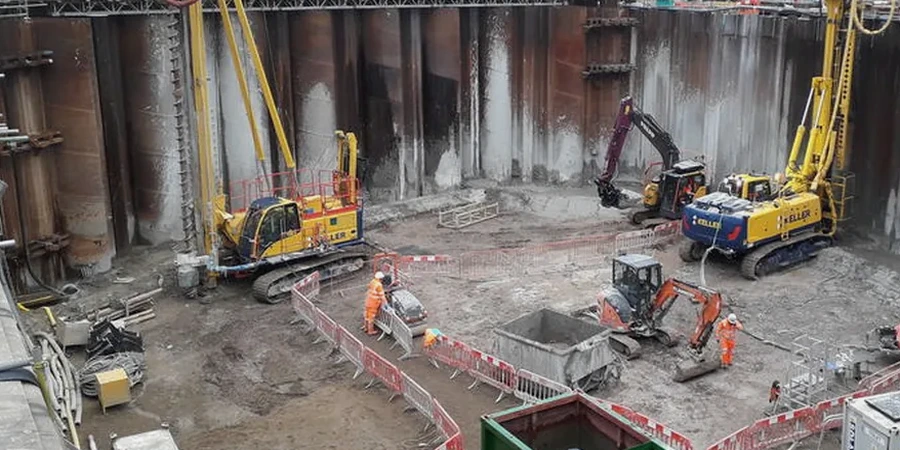
In Liverpool, much of the city’s geology sits on glacial till, laminated clays, and variable made ground from centuries of port activity. Jet grouting design here must account for these heterogeneous deposits, especially where old dock infill meets soft alluvial clays. We apply Eurocode 7 (BS EN 1997-1:2004) alongside BS 5930 for ground investigation to define column geometry, pressure parameters, and spoil return criteria. The method works well in confined urban sites where vibration from piling would risk damage to adjacent heritage structures. For deep soft layers we often complement the design with cimentaciones superficialesanalysis to verify bearing capacity after treatment. Every scheme we deliver in Liverpool starts with a detailed site investigation and a phased test-column programme to confirm the design assumptions before production begins.
Jet grouting design in Liverpool must account for variable made ground and laminated clays; trial columns before production are non-negotiable.
Process overview
One thing we see repeatedly in Liverpool is that the made ground contains brick, timber, and cobbles from historic demolition, which can deflect jet grouting rods if not identified early. Our design process starts with trial holes and probe drilling to map these obstructions, then we adjust the monitor nozzle configuration accordingly. We use single, double, and triple-fluid systems depending on the soil type and target strength: for silty sands a single-fluid system often suffices, while for stiff clays we switch to triple-fluid to improve erosion efficiency. Each column is designed with a minimum overlap of 0.1 m to guarantee continuity in cut-off walls, and we specify spoil management protocols that keep the site clean — critical when working next to the Mersey or within the city’s conservation areas. The whole approach relies on real-time monitoring of flow, pressure, and return density to maintain quality. For projects on old dock basins we also incorporate drenes-verticales to accelerate consolidation of underlying soft clays before jet grouting begins.
Technical reference image — Liverpool
Local context
The jet grouting rigs we mobilise in Liverpool are typically high-torque drill units mounted on tracked carriers, because many access points are narrow streets with listed buildings on both sides. We use low-headroom masts (under 4 m) for working beneath bridges or warehouse cantilevers. All equipment is fitted with automatic data loggers that record pressure, flow rate, and rod position every second — this data is reviewed daily to catch deviations early. The biggest risk in Liverpool’s ground is an untreated layer of silt or peat sandwiched between gravels; if the jet misses that lens, the column may lack continuity. We manage that by coring every twentieth production column and testing the core for strength and permeability. On waterfront sites we also monitor pore pressure nearby to avoid hydraulic fracture of buried operations.
This service complements our laboratory testing work for a complete project analysis.
Technical data
Parameter
Typical value
Column diameter
0.6 m – 2.5 m (depending on soil and fluid system)
Unconfined compressive strength (target)
1.0 – 5.0 MPa after 28 days
Permeability (design cut-off)
≤ 1×10⁻⁸ m/s
Maximum working pressure
400 – 600 bar (single-fluid); up to 500 bar (water/air in triple-fluid)
Rod retraction rate
10 – 40 cm/min (adjusted per soil stratum)
Spoil ratio (volumetric)
1.2 – 1.8 × theoretical column volume
Minimum column overlap (cut-off walls)
0.10 m
Additional services
01
Feasibility and conceptual design
Rapid assessment of jet grouting suitability based on existing ground investigation data, column geometry estimates, and cost benchmarking. Delivered within five working days for most Liverpool sites.
02
Detailed design and specification
Full design calculations in accordance with Eurocode 7, including column layout, overlap verification, spoil management plan, and QA/QC criteria. We produce construction-ready drawings and method statements.
03
Trial-column programme and validation
Supervision of trial columns on site, including coring, UCS testing, and permeability testing. We compare results against design assumptions and adjust parameters before production starts.
Relevant standards
Eurocode 7 (BS EN 1997-1:2004) – geotechnical design, BS 5930:2015 – Code of practice for ground investigations, CIRIA C579 – Jet grouting: a guide for civil engineers, BS 5930 – Standard practice for design and installation of groundwater monitoring wells (used for verification piezometers)
Common questions
When is jet grouting preferred over traditional piling in Liverpool?
Jet grouting works well where access is restricted, vibration must be minimal, or the ground contains obstructions like brick and timber. In Liverpool’s waterfront areas, it is often chosen for cut-off walls and underpinning because it can treat multiple soil types in one pass without the noise of driven piles.
How much does jet grouting design cost in Liverpool?
Design fees typically range between £1.500 and £5.670 depending on project complexity, number of trial columns, and level of supervision. This includes conceptual design, detailed calculations, trial-column specification, and final validation reporting.
What ground conditions in Liverpool affect jet grouting performance most?
Laminated glacial clays and made ground containing cobbles or demolition debris are the main challenges. Laminated clays require higher jet energy and slower retraction rates to achieve full erosion, while cobbles can deflect the rod — pre-drilling or probe holes are often needed to map them.
Do you provide jet grouting design for heritage buildings in Liverpool city centre?
Yes. We have designed jet grouting schemes for underpinning and cut-off walls adjacent to Grade I and Grade II listed structures in Liverpool. The low-vibration nature of the process makes it suitable for sensitive sites. We always include a trial column and monitoring plan approved by the local conservation officer.