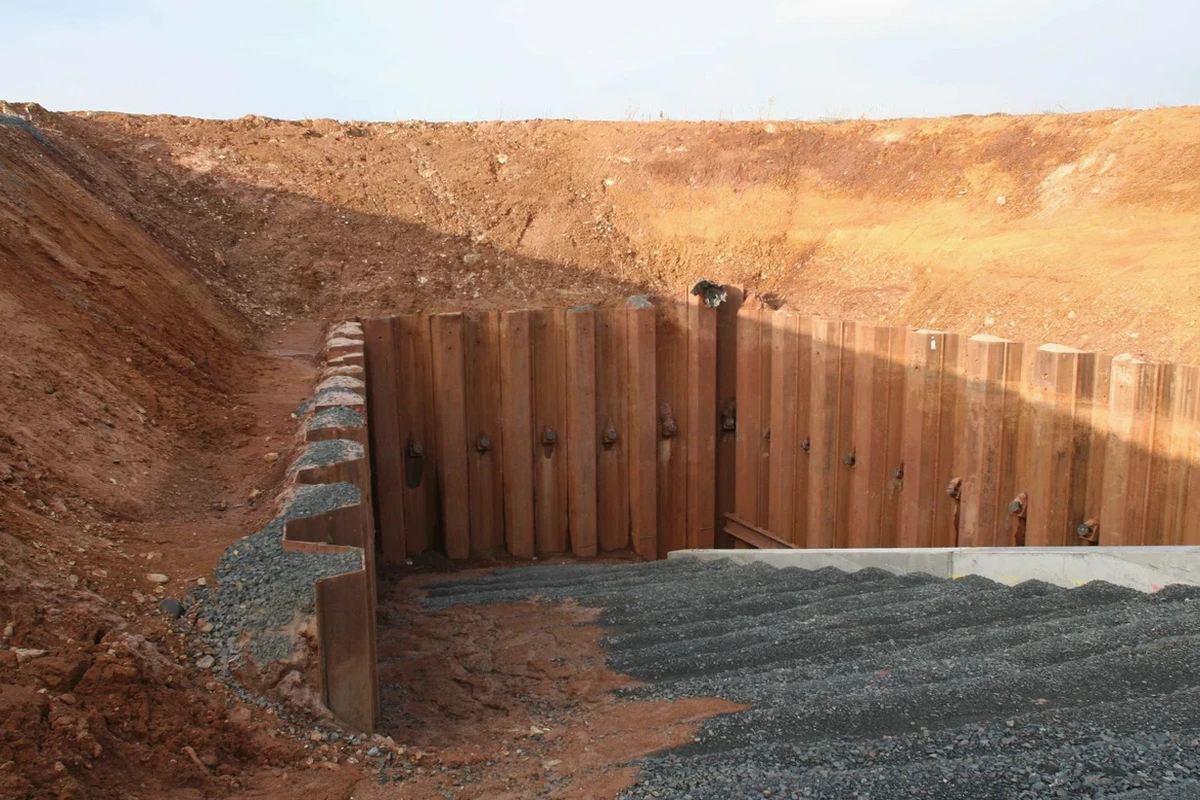
On the Mersey waterfront, a hydraulic piling rig drives interlocking steel sections into the soft laminated silts and glacial till that underlie Liverpool's docklands. The vibratory hammer sinks each AZ or PU profile to refusal depth while the operator monitors penetration rate and torque. Sheet pile wall design in Liverpool begins with a detailed ground investigation because the city's coastal geology — alluvial deposits overlying Triassic sandstone — creates variable embedment conditions. The team cross-references borehole logs with historic dock records to locate buried obstructions, old quay walls and abandoned infrastructure before finalising the retention system. A preliminary CPT survey often precedes the pile layout to map stratigraphic changes across the site and identify zones where driving refusal may occur.
Interlocking steel sections driven through Mersey alluvium must account for buried timber piles and abandoned dock structures that cause sudden refusal.
Process overview
A common mistake contractors make on Liverpool sites is assuming one pile section fits every reach. The Mersey corridor has a complex layering of soft silty clays, peat lenses and dense sands, so a uniform AZ-26 profile along a 200-metre quay wall can lead to over-design in some areas and structural risk in others. Competent sheet pile wall design in Liverpool tailors the section, steel grade, interlock type and toe level to the actual ground conditions encountered at each anchor bay. The design team runs finite-element models in Plaxis or similar software and checks the piling against BS EN 1997-1 (CEN 2004) for ULS and SLS. We also integrate stability of slopes into the analysis when the wall retains a fill embankment or a riverbank, ensuring global failure mechanisms are addressed alongside bending and anchor load.
Technical reference image — Liverpool
Local context
The water table in central Liverpool sits less than 2 metres below street level, and the underlying Mercia Mudstone Group can contain solution features that cause sudden loss of toe restraint. A poorly designed sheet pile wall in this setting may suffer excessive lateral deflection, rotation of the wall head, or even collapse of the retained ground. We model worst-case pore pressure scenarios using seasonal monitoring data from the Environment Agency and apply partial factors from UK National Annex to Eurocode 7. The analysis includes seepage gradients and potential piping beneath the toe, especially where the wall retains a tidal watercourse. A solid sheet pile wall design in Liverpool must also account for the dynamic loads from adjacent heavy traffic on the A5036 dock road.
Design of single- and multi-tier anchored sheet pile walls with ground anchors or deadman systems, including tendon stressing loads, corrosion protection and creep analysis per BS 8081.
02
Cantilever wall design
Free-standing and propped cantilever walls for excavations up to 8 m deep, with embedment checks, rotation limits and groundwater control measures integrated into the design.
03
Quay wall and waterfront design
Hydraulic and structural design of permanent sheet pile quay walls, including berthing and mooring loads, fender systems and scour protection for Liverpool dock basins.
This service complements our laboratory testing work for a complete project analysis.
Relevant standards
BS EN 1997-1:2004 (Eurocode 7 – Geotechnical design), BS EN 12063:1999 (Execution of sheet pile walls), BS 6349-2:2019 (Maritime works – Code of practice for the design of quay walls, jetties and dolphins), CIRIA C760 (Guidance on embedded retaining walls)
Common questions
How much does sheet pile wall design in Liverpool cost?
A typical design package for a small anchored wall (up to 50 m length) ranges between £1,010 and £1,800. Larger quay walls or complex multi-tier schemes may cost £2,500 to £3,700. The fee depends on the number of load cases, ground variability and the level of FEM modelling required.
What is the difference between a straight web and a Z-section pile?
Straight web piles (U-type) offer higher interlock strength and are better suited for cantilever walls in soft ground, while Z-sections carry out a higher section modulus per linear metre for anchored walls. In Liverpool's layered alluvium, Z-sections are often preferred for long quay walls because they reduce steel tonnage without sacrificing bending capacity.
Can sheet piles be installed near historic docks without damaging existing structures?
Yes, provided a pre-construction vibration assessment and a condition survey of adjacent masonry and brick walls are carried out. On Liverpool's Albert Dock and surrounding areas, we specify low-vibration press-in methods or pre-augering through fill to reduce ground displacement. The design must also account for the proximity of buried timber piles from the 19th century.